Top 10: Mulch Week edition
+ Highs and lows in Cleveland sports.

Ed. note: I’m switching this Friday newsletter to a classic Top 10-style feature, similar to several writers I admire (Austin Kleon, Wally Holland). On Tuesdays I send out a longer essay or reported feature that involves a bit more legwork; I’m taking a shot at a new paid subscription model to support those stories.
Thanks for reading. Enjoy the holiday weekend.
I’m choosing to write this piece between Games 1 and 2 of the Eastern Conference Finals. Whatever happened in Game 2, I’m either thrilled that we tied the series or I’m despondent again about the Cavs’ inexplicable post-season lethargy. It remains one of the greatest mysteries in modern Cleveland sports: Why does such a talented team chronically underperform when the moment matters most? No further comment on Game 1, except this: Kenny Atkinson remains seated far too long during games, and that fundamental fact redounds to the rest of his apparent coaching philosophy. And one more thing: James Harden should never have come to Cleveland.
It’s Mulch Week at our house, that delightful suburban springtime tradition. As I waited in the line at Lowe’s for my order of Sta-Green brand mulch, I couldn’t help but think of the opening page in Don DeLillo’s White Noise, one of favorite novels, where Jack Gladney is watching families drop off students, processionally, ritualistically, at College-on-the-Hill. It’s a great opening page1. And because I tend to indulge dumb literary itches like that, I wrote a piece about mulch as prayer:
The mulch arrives in April in convoys of shrink-wrapped abundance, pallets glistening outside big-box stores beneath a sky the color of unwashed aluminum. BLACK. BROWN. RED. The bags are printed with photographs of impossible lawns.
Inside, people wander the aisles in a narcotic spring delirium. The fertilizer aisle. The hose aisle. The aisle of fungicides and corrective granulars. People sense in this place the immense civic optimism of premium edging tools.
A man weighs two brands of mulch as if contemplating rival ideologies, old religions spawned from the woods. Somewhere overhead a television suspended near the checkout plays silent footage of flooding in a faraway nation. Closed captions crawl beneath the images. MARKETS REACT OFFICIALS WARN EXPERTS MONITOR
But here the mulch remains the central fact. The mulch means the season has turned. The mulch means you can still intervene.
You wheel it home in the family SUV beside electrolyte drinks and paper towels and twelve dollars worth of seed packets that will never germinate properly because nothing germinates properly anymore. Seasons arrive all wrong now, too early, too hot, atmospheric rivers forming overhead, a sharp frost in May. The meteorologists speak in strained, brightly managed tones, smiling beside maps colored the deep reds of internal organs.
The bags sweat in the driveway. You slit one open.
That smell.
The smell strikes some ancient chamber of the brain, the sweet rot of wet bark, heat rising from decomposition. It’s a forest floor rendered into consumer product. You stand there breathing it in longer than necessary while from inside the house your phone vibrates with notifications about tariffs, data breaches, outbreaks, a celebrity wellness cult operating offshore.
The mulch asks nothing of you except belief, and so you spread it around ornamental grasses genetically engineered to survive all USDA plant hardiness zones. You spread it while planes stitch white scars across the sky overhead. You spread it while somewhere far away a server farm the size of a township gulps electricity to generate synthetic customer service responses and AI romance companions and photorealistic advertisements for artisanal beef jerky.
A few houses down, a neighbor waves and you wave back with the rake. Neither of you knows how to discuss the sensation that history itself has become chemically unstable; instead you discuss rainfall totals, the local sports teams, the city’s recycling protocol.
The thing about mulch is that it creates borders, clear distinctions between chaos and order. This matters profoundly to Americans. We are a people obsessed with containment. We like storage bins, passwords, privacy fences, climate-controlled garages. The mulch bed is a tiny managed republic at the edge of the abyss.
For several weeks after application everything appears briefly possible. The hostas flare green. The tulips rise. The dark mulch radiates a rich visual seriousness.
You stand at the window holding coffee and experience an emotion adjacent to hope. Then the summer advances.
The mulch fades, and the weeds return in strange militant formations. A raccoon tears through the beds at night with the determination of a revolutionary cell. Heat settles over the subdivision in visible waves. The local news warns elderly residents not to remain outside for extended periods. Children run through sprinklers while their parents refresh radar maps tracking storms with algorithmically generated names. The nights become enormous.
You lie awake hearing distant highway noise and the soft ticking of the cooling house and you think about the bags of mulch slowly decomposing outside beneath the hydrangeas, matter returning to matter, trees reduced to fragrant memories rooted in decorative ecosystems beside homes financed into the middle decades of a century no one fully believes in anymore.
And still.
Still the instinct persists. Next spring you will buy more.
You will return to the garden center under the enormous flags snapping in petrochemical wind. You will touch the bags and compare prices and squint at labels promising moisture retention and vibrant color enhancement, because the mulch is ritual. It is a suburban form of prayer. It is a dark and fragrant buffer placed carefully between ourselves and the rising static of the world.
OK then. How about a Netflix rec? Marty, Life Is Short, the new documentary on Martin Short’s life and work, is outstanding. We ended up watching it right after The Crash, the documentary on the horrible car crash in Strongsville a few years ago, a real pit of nihilism and hopelessness. So, it was a nice way to salvage the evening, so to speak. Bizarre double feature. At any rate, Marty is a pitch-perfect film that glamorizes the fun side of life, the joy of taking things not-very-seriously but always committing to the act of love. It’s got enough Hollywood in it without being too circle-jerky, as these things can sometimes be, and it’s even got John Mulaney, I comedian I can’t stand, dropping a great line about the subject: “Marty is good at life.” The secret, more or less, is in laughter.
Love this brief report on a nice sequence in Wednesday’s Guardians-Tigers game:

Speaking of our Guardians, here’s another nice stat pulled by Cade Cracas:
Dating back to 1901, the Cleveland Guardians hold a two-game advantage in the all-time head-to-head record against the Tigers:
Cleveland: 1,166-1,164-12
Detroit: 1,164-1,166-12
Nearly 2,500 games have been played between the two in-division rivals.Make that a three-game advantage after Thursday’s sweep.
I’ve wanted to write something about this great opinion piece in the New York Times from earlier in the week, but it’s hard to pin down. It does seem true, though: Increasingly, people turn toward supernatural belief and orthodoxy to find meaning in their lives, to find some sort of grand narrative, to believe in something beyond themselves. In the 20th century, this was easy enough, hence the rise of modernism. Then postmodernism, my personal fave, crept in. Now, as the 21st century fragments our shared institutions further, we’re trying collectively to pick up the pieces and stitch them into a grand narrative again, which is… what? Something like religion, wellness, money, aliens? It’s not materialism, really, because no one can afford much of anything anymore, despite ballooning credit card debt (or maybe evidenced by it). So what is it then? “We are sliding back into the Middle Ages,” says the NYT guest writer.
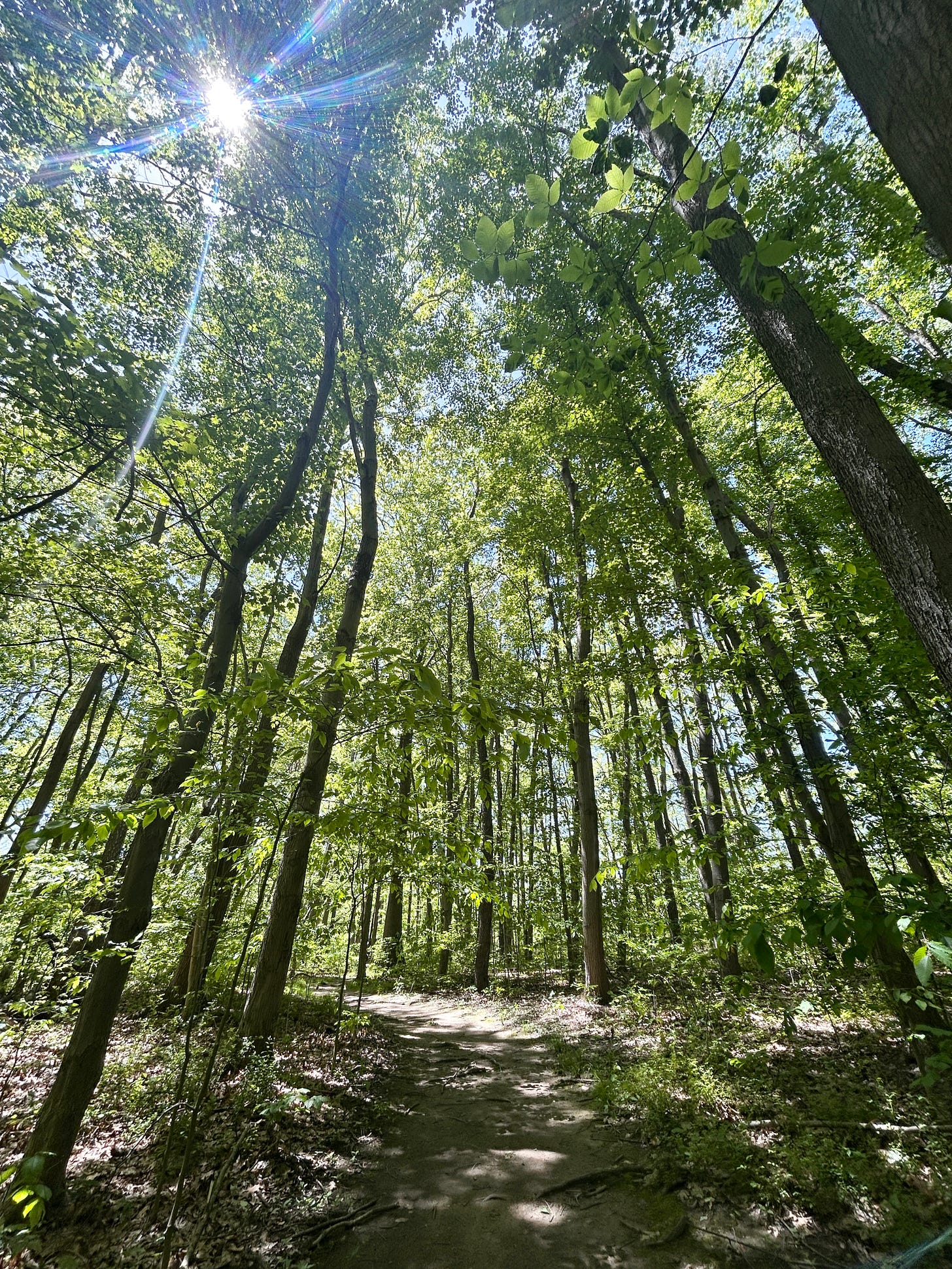
This week’s hike was a nice post-storm jaunt along the Schumacher Trail in Akron. Here in Northeast Ohio, the Cleveland Metroparks get the spotlight, but I’d argue that the Summit Metro Parks, around Akron, have the better hiking. Cleveland’s “Emerald Necklace” is elite, no doubt, but most days give me Summit County’s hills (and of course the Cuyahoga Valley National Park down here) for pure trail bliss.
Every year, Summit Metro Parks hosts the Fall Hiking Spree from September through November. Join me.
I’m relatively active on a Phish community message board (go figure), and one of the topics this week was a little nostalgia trip through the band’s “early 3.0” period, which roughly corresponds to the reunion in 2009 up ‘til Magnaball in mid-2015. It’s a great if rather uneven era for the band not exactly short on great and uneven eras, and I shared a few thoughts on what I loved about 2010-2011 Phish. Namely, I take every opportunity I can to share the jam out of “Down With Disease” from 6/3/11 in Clarkston, Mich. The video below was more or less my vantage point from the lawn that night, and, wow, what a night it was! Fifteen years later, I can still see it all in my mind, see the surge of energy through the crowd as the band worked through a series of arpeggios to get to a jam based on Coltrane’s “A Love Supreme.” The madness started around the 5-min. mark in the video below, with Trey coming in around 6:00. It’s still one of the best moments of improvised music I’ve ever seen.
I’m a big fan of what Samgar Renkena is doing on Substack: small drawings, one a day, that tell a story, although there’s no further commentary than the art itself.
Birdie Corner: No birdie in last week’s newsletter, because I didn’t get out in time. But! My nearly one-birdie-per-round pace continues in 2026 with a goodie on No. 2 at Ellsworth Meadows in Hudson. We started on 10, so this was our back nine. I had a healthy par on No. 1, that long and slightly dog-leg par-5 to open the course, with a great drive, an absolutely striped 6-iron to the front of the green, simple chip and two-putt. So, staring down the short-and-tight No. 2, with a tricky tree on the right side of the fairway, I went back to the 6-iron. No funny business: Just get into the middle of the fairway. It worked great, and I followed that with a neat 48-degree gap wedge to a few feet above the hole. Dicey putt, breaking hard left-to-right, but I nailed it with the gentlest stroke possible.