
Top 10: Birdwatching edition
+ A brief review of John Updike's Rabbit novels.

Ed. note: I’m switching this Friday newsletter to a classic Top 10-style feature, similar to several writers I admire (Austin Kleon, Wally Holland). On Tuesdays I send out a longer essay or reported feature that involves a bit more legwork; I’m taking a shot at a new paid subscription model to support those stories.
Thanks for reading.
It’s the Biggest Week in American Birding, which in some circles is a far far better thing than the Superbowl, the Kentucky Derby, and the lower Oakland roller derby finals all rolled into one. In 2017, I went to Magee Marsh in Northwest Ohio to learn more. It’s one of my favorite pieces I’ve ever written.
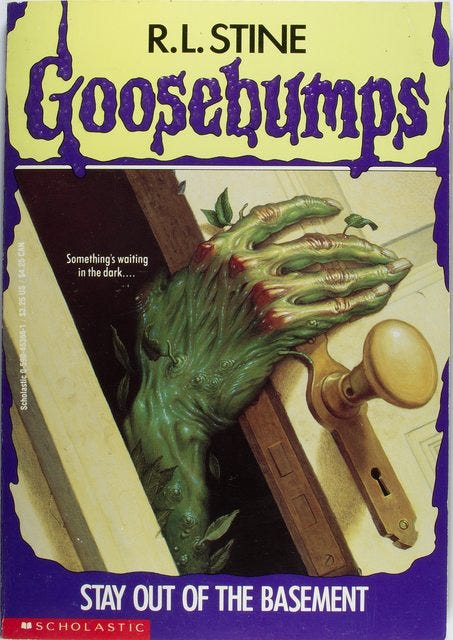
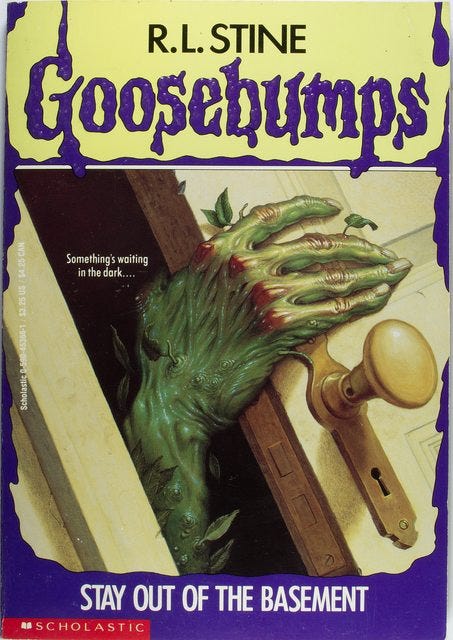
On a recent library run, this time in downtown Akron, I picked up an old Goosebumps book just for fun. We already had a stack about a half a yard high of children’s books for the kids; I thought this one would be a nostalgic thing to zip through. (It was Stay Out of the Basement, No. 2 in the original run.) Instead, our 3-, nearly 4-year-old daughter wanted me to read it to her. Cautiously, I did. We breezed through it in a day or two; she thought it was “cool” and “a little scary” but mostly “so cool.” I think she thought it was vaguely and mysteriously funny to read about a plant monster, a guy with leaves coming out of his head. Listen, I loved the Goosebumps series as a kid. The cover art by Tim Jacobus is incredible; just looking through the original series is enough to transport me back to 1996, 1997, eagerly looking for the latest release at Borders in Westlake. How far we take this with our kids at their ages is another story, but for now I’ll count it as a fun win.
In more adult-themed books, I finished the Rabbit tetralogy by John Updike this past week. They were amazing, and well worth reading even if the social norms and cultural boundary-pushing of the late ‘50s, ‘60s, ‘70s and ‘80s feel jarring today. Updike’s prose—well, his reputation doesn’t need much embellishing, but indulge me briefly for a review of this incredible run of novels, including two legitimate claims to Great American Novel territory:
The Rabbit books feel less like distinct novels than weather systems. You don’t so much read them as inhale them, live with them, great doorstopper hulks holding a vigil on your bedside table for a few months. The prose, which is beautiful from one sentence to the next, arrives in waves, thick with cigarette smoke, adultery, ice cubes knocking against glassware, the damp upholstery smell of postwar American striving. We see men in short-sleeve dress shirts stand in kitchens lit by refrigerator bulbs at midnight. We see women move with a radiance that is at once intensely observed and, often painfully, imprisoned by the observing eye. Children drift at the edges of view. Every lawn seems recently watered. Every soul seems faintly dehydrated.
And still, the pleasure of reading Updike remains almost physically overwhelming. It’s easy to dismiss him in the canon of American lit (“a minor novelist with a major style,” sez Harold Bloom), but the Updikean gaze pierces both the human soul and the American century.
He was flawed, even in his own time. The misogyny on display can feel less incidental than atmospheric and almost wanton; women are too often rendered as surfaces onto which male panic, desire, resentment, and spiritual confusion are projected. There are passages that make you wince before you can admire them. Sometimes both reactions happen in the same sentence. But the sentences remain alive in a way contemporary fiction rarely permits itself to be alive anymore. Why is that?
Updike notices everything. Do people notice as much as they used to? He goes beyond mere MFA workshop-level detail to engage the almost dangerous sense that the physical world appears to be continuously erupting into metaphor around him. A car dealership at dusk becomes a theology of decline. The sheen on a basketball court carries the ache of vanished youth. American abundance itself—Hi-C cartons, split-level homes, golf umbrellas, shag carpeting, supermarket peaches—is transformed into a kind of spiritual evidence. The Rabbit books understand consumer America as texture, as weather, as the substance through which people attempt, and fail, to save themselves. In this Updike’s flaws are transcended by greater truths that are still relevant today.
And that’s what still feels so exhilarating about reading Updike: his absolute refusal to separate the trivial from the eternal.
Rabbit buys a Toyota and somehow it matters cosmically. He lusts, lies, sweats, cheats, drifts, eats peanuts at parties, watches television, worries about money, notices breasts, notices clouds, notices his own aging body with horror. Meanwhile America itself moves beneath him decade by decade, the Eisenhower years giving way to Vietnam, then inflation and an oil crisis, then Reaganite prosperity, then the strange spiritual vacancy of late-century affluence. The country changes its carpeting, its engines, its cocktails, its waistlines. Rabbit keeps running anyway, less toward freedom than toward some impossible state of sufficient aliveness. And Updike, sentence by sentence, keeps making the ordinary world shimmer beyond its actual capacity to shimmer.
The books are flawed in enormous, obvious, unavoidable ways. They are also miraculous. Which may, unfortunately, be part of what real literature so often is: morally compromised, spiritually restless, embarrassingly human.
Updike won two Pulitzer Prizes for Rabbit Is Rich and Rabbit at Rest. This week, the 2026 Pulitzers were announced. The one I’d like to shout out is the award for international reporting, won this year by a team at the Associated Press that includes reporter Dake Kang, briefly a Cleveland-based reporter ca. 2017. He’s been at the Beijing bureau ever since, earning his way to this award “for an astonishing global investigation into state-of-the-art tools of mass surveillance, created in Silicon Valley, advanced in China and spreading worldwide before returning to America for secret new uses by the U.S. Border Patrol.”
Read the full series of stories here.
Birdie Corner: With any luck, I’ll make this a semi-regular feature. Last week I recounted a birdie on No. 18 at Manakiki. This week, a birdie on No. 14 at Sleepy Hollow (but don’t look at the rest of my scorecard, please god no). Much has been written about this hole, a dramatic par-5 (see below), even if the canyon that runs along the final 150 yards has given over to forest. If you can draw your tee shot to the farthest left edge of the fairway, you’re in position to go for the green, wrapping your second shot around trees, to set up a look at eagle or birdie. If your drive ends up anywhere else, this hole plays nicely as a true three-shotter, and birdie is certainly in play. This week, my drive cut off to the right, and I was mostly blocked by those trees. I had to take a pitching wedge across the ravine to the second stretch of fairway. From there, I had 120 yards in, a good test for my new 48-degree PING S259 wedge. I placed the shot perfectly, landing it six feet from the pin and then knocked it in.

I wrote about data centers this past Tuesday and how the public is meant to engage with these mysterious development projects. Then, days later, Ken Prendergast reported that $1.6-billion, 150-megawatt data center campus comprising three buildings set on 35 acres in Slavic Village is now proposed for Cleveland. Watch this project.
I can’t understand the Cavs’ post-season energy these past four years. What a disaster. Their performances generally have been inexplicable, ranking among the greatest unanswerable questions in modern Cleveland sports history. I’ve thought this week about an imagined future interview with Donovan Mitchell or Evan Mobley, long after they’re done playing, where a Charlie Rose-type interviewer finally asks them, directly, what happened back then? How can such a talented team just fall on its face, over and over, when it matters most?
Phish recently wrapped their nine-show residency at Sphere in Las Vegas. I was fortunate enough to catch their first-ever show there, April 18, 2024, but this 2026 run is full of gems. Even if you’re not a fan, the pure rock ‘n’ roll intrigue is fascinating. The band played nine shows featuring 162 songs (no repeats) all set to a hybrid of live video/light improvisation and pre-designed world-building visuals. The clip below is an example of the former, with lighting director Chris Kuroda tapping into the Sphere itself to work the lights and mimic the feel of a typical Phish show. The band is in its 43rd year, playing yet again at a new high-water mark of virtuosity and creativity. Summer tour starts in two months.
More budget cuts at Cleveland State University in the offing. I’ll have more on this in a future newsletter, or least an angle on this news, but it's telling that this story grants anonymity to someone in the CSU English Dept. who believed, probably rightfully, that speaking out about the importance of poetry would cost them their job. What a world.
Here it is, your moment of Zen.