
The wetlands behind the cloud
A little-known environmental marketplace is struggling to absorb the unprecedented scale of AI infrastructure.

When Drausin Wulsin’s father purchased the farmland in Pike County, Ohio, in the southernmost part of the state, back in the 1960s, the tenant farmer on-site offered a warning: “You bought a swamp.”
The remark was not intended as praise.
The property sat in a broad valley where water had a habit of lingering. Decades earlier, the U.S. Army Corps of Engineers had straightened out a creek that ran through the bottom ground, to promote agriculture, but floodwater periodically spread across the fields. Beneath the rich soil lay a seam of clay left behind from an ancient lake bed, trapping moisture close to the surface. Some areas were so wet that machinery struggled to cross them. For generations, farmers worked to move the water elsewhere. The land remained stubborn, as lands tends to be.
“The ground was always wanting to be wet,” Wulsin told me over the phone.
It is an observation about a farm, but it could just as easily serve as a description of the last century of environmental and even economic policy in America. Much of modern development has involved convincing landscapes to become something other than what they were. Wetlands became farms, which became suburbs, which became industrial parks. Rivers were straightened, and forests were cleared. Water, everywhere, was redirected. Nature was managed every step of the way, like it or not.
Ohio lost roughly 90% of its original wetlands. Over generations they were drained, filled, channelized, and converted to agricultural and industrial use. For a long time, this was simply considered progress.
Then, gradually, another idea emerged. If development was going to continue—and few people seriously believed it would stop—perhaps the damage could at least be measured, offset; perhaps impacts could be quantified. Perhaps, even, developers could be required to compensate for what they altered.
This idea eventually produced one of the strangest and least visible marketplaces in modern America.
The marketplace of wetland trading
Today, if a company wants to build a highway, a subdivision, a pipeline, a solar farm, or a data center that impacts wetlands, regulators often require compensation elsewhere. Wetlands destroyed in one location must be offset by wetlands restored in another. The mechanism is known as mitigation banking.
Wulsin’s farm became part of that system more than two decades ago. I called him to learn more about how his 456-acre wetland project at Red Stone Farm fits into the biggest business story in the U.S. right now: the rapid development of hyperscale data centers.
What began in Wulsin’s case as a plot of farmland rich in hydric soil has become, in part, a wetland mitigation bank. Over the years, he broke down the drainage systems, and water gradually returned. To revive the land, Wulsin and his team planted trees, monitored hydrology, catalogued plant species. The work unfolded slowly under the supervision of regulators and ecologists who released wetland credits only after progress could be demonstrated. The process was expensive and uncertain.
Red Stone Farm officially entered the mitigation market in 2008, just as the financial crisis was unfolding. “We incurred all these costs to develop this wetland, and we had no sales for three years,” Wulsin recalled. “That was problematic. That was stressful.”
His wetlands came along, though, and he accrued credits, but buyers were hard to come by in those lean and early years.
Eventually the Ohio Department of Transportation arrived as a customer for Wulsin’s wetland credits. Other projects followed. Housing developments, infrastructure improvements, the occasional industrial project. Over time, the restored landscape became part of an environmental accounting system that most Americans have never heard of.
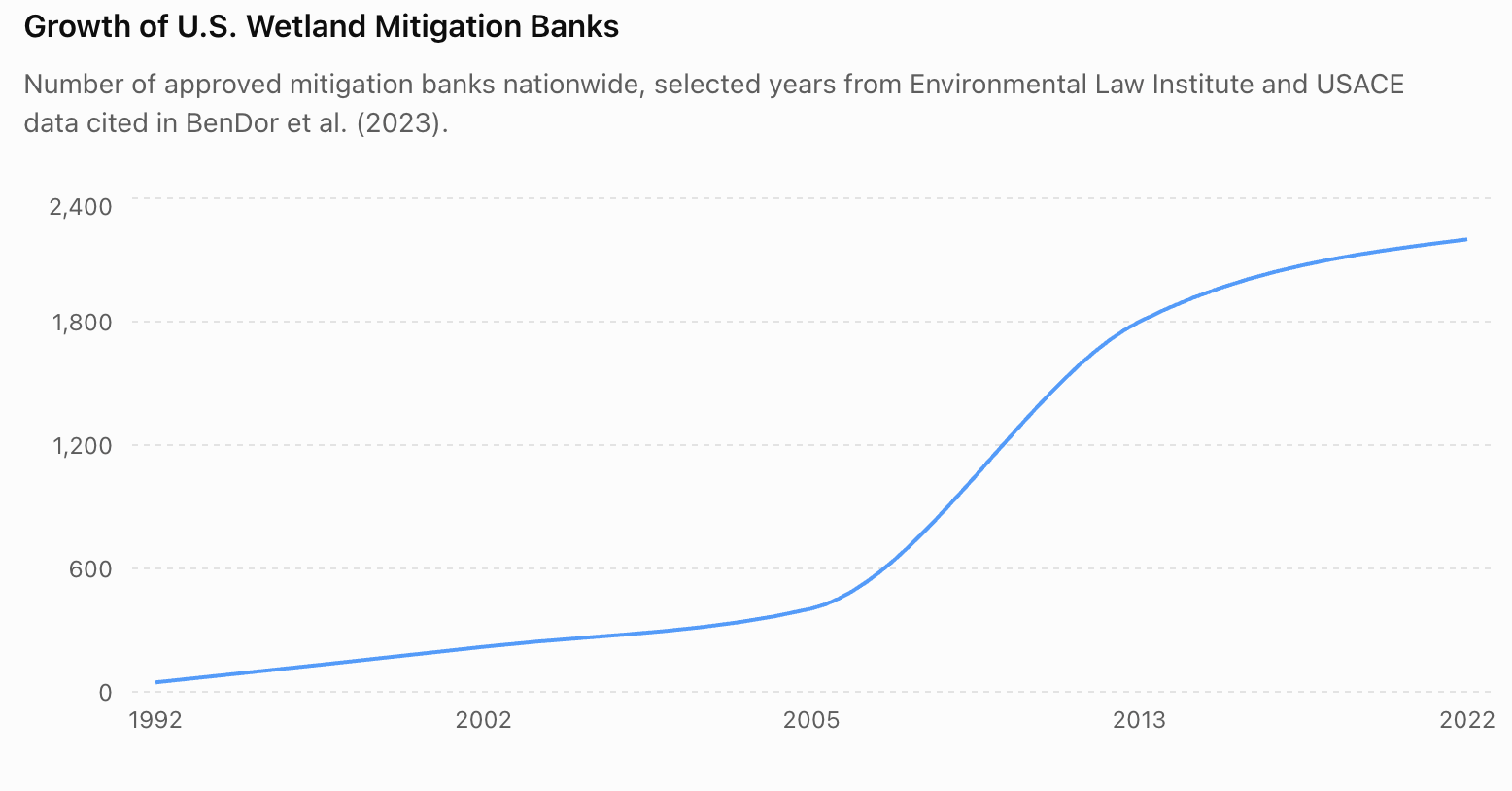
Developers inevitably take from the land, which often includes demarcated wetlands, and mitigation banks supply a way to offset that. As of 2023, research suggested that the U.S. wetland mitigation bank marketplace included at least 2,200 such banks.
Generally, mitigation banks do not create their own market; demand arises whenever roads, subdivisions, pipelines, industrial facilities, or other projects impact regulated wetlands and must compensate for those impacts elsewhere. Because that demand is tied both to economic growth and environmental regulation, the industry experiences significant volatility, with bankers describing years of strong sales followed by years of little activity.
“You are a source of wetland credits for developers who are incurring wetland debits,” Wulsin explained.
The remarkable thing is how many parts of modern life depend on this marketplace; when communities welcome new housing or school buildings, in many cases, wetland development must be taken into account. It’s a relatively small slice of the broader economic development story, a simple if uneasy attempt to strike a balance in given watershed.
“We typically sell credits to housing developers, and they do everything they can to avoid impacting wetlands,” Wulsin said, “but maybe they need 2/10 of a credit or 5/10 of a credit.”
A new customer is throwing that delicate balance out of whack.
“These data centers,” Wulsin said, “they need scores, dozens of credits. They put this huge demand on the credit system. They're sucking up all the supply of credits.”
Project Dazzler
Sixty years after a tenant farmer warned of swamp conditions on nearby land, Google arrived. Ohio regulators approved a permit this spring to allow Google to impact wetlands in the Little Scioto-Tygarts watershed as part of its proposed Project Dazzler data center campus in Scioto County. The project would convert roughly 800 acres into a major digital-industrial site, requiring new electrical infrastructure, environmental permits, and, yes, wetland mitigation credits.
While publicly framed as an economic-development project, Dazzler is also part of a much larger national buildout as technology companies race to secure the land, power, water, and regulatory approvals needed to support the explosive growth of AI. The buildout arrives in headlines, in permit approvals, in local council discussions, often obfusucated from the local public by early non-disclosure agreements and the invocation of vague LLCs.
In Dazzler’s case, under the guise of Tilted Gate LLC, rather than Google itself, the permit contained a striking sentence: “A lowering of water quality in the Little Scioto-Tygarts watershed is necessary.”
The permit acknowledges in plain language that something will be lost. It simultaneously argues that the loss is acceptable. What follows is compensation.
On June 11, the day after the permit was issued, the data center project paid Red Stone Farm Wetland Mitigation Bank $1.94 million for 25.3 wetland mitigation credits.
The project also paid the Stream + Wetlands Foundation $1.967 million for 17.1 acres of forested wetland credits and 11 acres of non-forested wetland credits; those Stream + Wetlands Foundation credits are what’s know as “in-lieu fees,” meaning those credits are promises of future wetland restoration. The in-lieu fee program is an oddity in this already unusual marketplace, a French-derived I.O.U. that acts as a pressure-release valve when demand for wetland credits outstrips supply.
In total, Project Dazzler’s developers spent roughly $4 million on wetland credits associated with Project Dazzler. For a broader company worth roughly $4.2 trillion, the sum barely registers. For a former swamp in Pike County, it represents one of the more remarkable economic transformations imaginable.
The balance is part of the broader American story unfolding in the 2020s. Artificial intelligence is often discussed in terms of software, algorithms, and trillion-dollar market valuations. Yet each new wave of computation must ultimately land somewhere as concrete, steel, transmission infrastructure, cooling equipment, and permits. The AI boom is creating many things and one of those things is demand for land. It is also creating demand for water. It is creating demand for wetlands.
